Z3
 
Loading...
Searching...
No Matches
Public Member Functions | Data Fields
DatatypeSortRef Class Reference
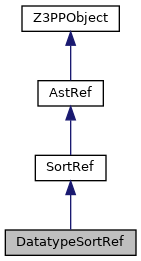
+ Inheritance diagram for DatatypeSortRef:

Public Member Functions

 num_constructors (self)
 
 constructor (self, idx)
 
 recognizer (self, idx)
 
 accessor (self, i, j)
 
- Public Member Functions inherited from SortRef
 as_ast (self)
 
 get_id (self)
 
 kind (self)
 
 subsort (self, other)
 
 cast (self, val)
 
 name (self)
 
 __eq__ (self, other)
 
 __ne__ (self, other)
 
 __gt__ (self, other)
 
 __hash__ (self)
 
- Public Member Functions inherited from AstRef
 __init__ (self, ast, ctx=None)
 
 __del__ (self)
 
 __deepcopy__ (self, memo={})
 
 __str__ (self)
 
 __repr__ (self)
 
 __nonzero__ (self)
 
 __bool__ (self)
 
 sexpr (self)
 
 ctx_ref (self)
 
 eq (self, other)
 
 translate (self, target)
 
 __copy__ (self)
 
 hash (self)
 
 py_value (self)
 
- Public Member Functions inherited from Z3PPObject
 use_pp (self)
 

Data Fields

 ast
 
 ctx
 
- Data Fields inherited from SortRef
 ast
 
 ctx
 
- Data Fields inherited from AstRef
 ast
 
 ctx
 

Additional Inherited Members

- Protected Member Functions inherited from Z3PPObject
 _repr_html_ (self)
 

Detailed Description

Datatype sorts.

Definition at line 5437 of file z3py.py.

Member Function Documentation

◆ accessor()

accessor (   self,
  i,
  j 
)
In Z3, each constructor has 0 or more accessor.
The number of accessors is equal to the arity of the constructor.

>>> List = Datatype('List')
>>> List.declare('cons', ('car', IntSort()), ('cdr', List))
>>> List.declare('nil')
>>> List = List.create()
>>> List.num_constructors()
2
>>> List.constructor(0)
cons
>>> num_accs = List.constructor(0).arity()
>>> num_accs
2
>>> List.accessor(0, 0)
car
>>> List.accessor(0, 1)
cdr
>>> List.constructor(1)
nil
>>> num_accs = List.constructor(1).arity()
>>> num_accs
0

Definition at line 5500 of file z3py.py.

5500 def accessor(self, i, j):
5501 """In Z3, each constructor has 0 or more accessor.
5502 The number of accessors is equal to the arity of the constructor.
5503
5504 >>> List = Datatype('List')
5505 >>> List.declare('cons', ('car', IntSort()), ('cdr', List))
5506 >>> List.declare('nil')
5507 >>> List = List.create()
5508 >>> List.num_constructors()
5509 2
5510 >>> List.constructor(0)
5511 cons
5512 >>> num_accs = List.constructor(0).arity()
5513 >>> num_accs
5514 2
5515 >>> List.accessor(0, 0)
5516 car
5517 >>> List.accessor(0, 1)
5518 cdr
5519 >>> List.constructor(1)
5520 nil
5521 >>> num_accs = List.constructor(1).arity()
5522 >>> num_accs
5523 0
5524 """
5525 if z3_debug():
5526 _z3_assert(i < self.num_constructors(), "Invalid constructor index")
5527 _z3_assert(j < self.constructor(i).arity(), "Invalid accessor index")
5528 return FuncDeclRef(
5529 Z3_get_datatype_sort_constructor_accessor(self.ctx_ref(), self.ast, i, j),
5530 ctx=self.ctx,
5531 )
5532
5533
Z3_func_decl Z3_API Z3_get_datatype_sort_constructor_accessor(Z3_context c, Z3_sort t, unsigned idx_c, unsigned idx_a)
Return idx_a'th accessor for the idx_c'th constructor.

◆ constructor()

constructor (   self,
  idx 
)
Return a constructor of the datatype `self`.

>>> List = Datatype('List')
>>> List.declare('cons', ('car', IntSort()), ('cdr', List))
>>> List.declare('nil')
>>> List = List.create()
>>> # List is now a Z3 declaration
>>> List.num_constructors()
2
>>> List.constructor(0)
cons
>>> List.constructor(1)
nil

Definition at line 5453 of file z3py.py.

5453 def constructor(self, idx):
5454 """Return a constructor of the datatype `self`.
5455
5456 >>> List = Datatype('List')
5457 >>> List.declare('cons', ('car', IntSort()), ('cdr', List))
5458 >>> List.declare('nil')
5459 >>> List = List.create()
5460 >>> # List is now a Z3 declaration
5461 >>> List.num_constructors()
5462 2
5463 >>> List.constructor(0)
5464 cons
5465 >>> List.constructor(1)
5466 nil
5467 """
5468 if z3_debug():
5469 _z3_assert(idx < self.num_constructors(), "Invalid constructor index")
5470 return FuncDeclRef(Z3_get_datatype_sort_constructor(self.ctx_ref(), self.ast, idx), self.ctx)
5471
Z3_func_decl Z3_API Z3_get_datatype_sort_constructor(Z3_context c, Z3_sort t, unsigned idx)
Return idx'th constructor.

Referenced by DatatypeSortRef.accessor().

◆ num_constructors()

num_constructors (   self)
Return the number of constructors in the given Z3 datatype.

>>> List = Datatype('List')
>>> List.declare('cons', ('car', IntSort()), ('cdr', List))
>>> List.declare('nil')
>>> List = List.create()
>>> # List is now a Z3 declaration
>>> List.num_constructors()
2

Definition at line 5440 of file z3py.py.

5440 def num_constructors(self):
5441 """Return the number of constructors in the given Z3 datatype.
5442
5443 >>> List = Datatype('List')
5444 >>> List.declare('cons', ('car', IntSort()), ('cdr', List))
5445 >>> List.declare('nil')
5446 >>> List = List.create()
5447 >>> # List is now a Z3 declaration
5448 >>> List.num_constructors()
5449 2
5450 """
5451 return int(Z3_get_datatype_sort_num_constructors(self.ctx_ref(), self.ast))
5452
unsigned Z3_API Z3_get_datatype_sort_num_constructors(Z3_context c, Z3_sort t)
Return number of constructors for datatype.

Referenced by DatatypeSortRef.accessor(), DatatypeSortRef.constructor(), and DatatypeSortRef.recognizer().

◆ recognizer()

recognizer (   self,
  idx 
)
In Z3, each constructor has an associated recognizer predicate.

If the constructor is named `name`, then the recognizer `is_name`.

>>> List = Datatype('List')
>>> List.declare('cons', ('car', IntSort()), ('cdr', List))
>>> List.declare('nil')
>>> List = List.create()
>>> # List is now a Z3 declaration
>>> List.num_constructors()
2
>>> List.recognizer(0)
is(cons)
>>> List.recognizer(1)
is(nil)
>>> simplify(List.is_nil(List.cons(10, List.nil)))
False
>>> simplify(List.is_cons(List.cons(10, List.nil)))
True
>>> l = Const('l', List)
>>> simplify(List.is_cons(l))
is(cons, l)

Definition at line 5472 of file z3py.py.

5472 def recognizer(self, idx):
5473 """In Z3, each constructor has an associated recognizer predicate.
5474
5475 If the constructor is named `name`, then the recognizer `is_name`.
5476
5477 >>> List = Datatype('List')
5478 >>> List.declare('cons', ('car', IntSort()), ('cdr', List))
5479 >>> List.declare('nil')
5480 >>> List = List.create()
5481 >>> # List is now a Z3 declaration
5482 >>> List.num_constructors()
5483 2
5484 >>> List.recognizer(0)
5485 is(cons)
5486 >>> List.recognizer(1)
5487 is(nil)
5488 >>> simplify(List.is_nil(List.cons(10, List.nil)))
5489 False
5490 >>> simplify(List.is_cons(List.cons(10, List.nil)))
5491 True
5492 >>> l = Const('l', List)
5493 >>> simplify(List.is_cons(l))
5494 is(cons, l)
5495 """
5496 if z3_debug():
5497 _z3_assert(idx < self.num_constructors(), "Invalid recognizer index")
5498 return FuncDeclRef(Z3_get_datatype_sort_recognizer(self.ctx_ref(), self.ast, idx), self.ctx)
5499
Z3_func_decl Z3_API Z3_get_datatype_sort_recognizer(Z3_context c, Z3_sort t, unsigned idx)
Return idx'th recognizer.

Field Documentation

◆ ast

ast

◆ ctx

ctx

Definition at line 5470 of file z3py.py.

Referenced by ArithRef.__add__(), BitVecRef.__add__(), BitVecRef.__and__(), FuncDeclRef.__call__(), AstMap.__contains__(), AstRef.__copy__(), Goal.__copy__(), AstVector.__copy__(), FuncInterp.__copy__(), ModelRef.__copy__(), AstRef.__deepcopy__(), Datatype.__deepcopy__(), ParamsRef.__deepcopy__(), ParamDescrsRef.__deepcopy__(), Goal.__deepcopy__(), AstVector.__deepcopy__(), AstMap.__deepcopy__(), FuncEntry.__deepcopy__(), FuncInterp.__deepcopy__(), ModelRef.__deepcopy__(), Statistics.__deepcopy__(), Context.__del__(), AstRef.__del__(), ScopedConstructor.__del__(), ScopedConstructorList.__del__(), ParamsRef.__del__(), ParamDescrsRef.__del__(), Goal.__del__(), AstVector.__del__(), AstMap.__del__(), FuncEntry.__del__(), FuncInterp.__del__(), ModelRef.__del__(), Statistics.__del__(), Solver.__del__(), ArithRef.__div__(), BitVecRef.__div__(), ExprRef.__eq__(), ArithRef.__ge__(), BitVecRef.__ge__(), AstVector.__getitem__(), ModelRef.__getitem__(), Statistics.__getitem__(), AstMap.__getitem__(), ArithRef.__gt__(), BitVecRef.__gt__(), BitVecRef.__invert__(), ArithRef.__le__(), BitVecRef.__le__(), AstVector.__len__(), AstMap.__len__(), ModelRef.__len__(), Statistics.__len__(), BitVecRef.__lshift__(), ArithRef.__lt__(), BitVecRef.__lt__(), ArithRef.__mod__(), BitVecRef.__mod__(), BoolRef.__mul__(), ArithRef.__mul__(), BitVecRef.__mul__(), ExprRef.__ne__(), ArithRef.__neg__(), BitVecRef.__neg__(), BitVecRef.__or__(), ArithRef.__pow__(), ArithRef.__radd__(), BitVecRef.__radd__(), BitVecRef.__rand__(), ArithRef.__rdiv__(), BitVecRef.__rdiv__(), ParamsRef.__repr__(), ParamDescrsRef.__repr__(), AstMap.__repr__(), Statistics.__repr__(), BitVecRef.__rlshift__(), ArithRef.__rmod__(), BitVecRef.__rmod__(), ArithRef.__rmul__(), BitVecRef.__rmul__(), BitVecRef.__ror__(), ArithRef.__rpow__(), BitVecRef.__rrshift__(), BitVecRef.__rshift__(), ArithRef.__rsub__(), BitVecRef.__rsub__(), BitVecRef.__rxor__(), AstVector.__setitem__(), AstMap.__setitem__(), ArithRef.__sub__(), BitVecRef.__sub__(), BitVecRef.__xor__(), DatatypeSortRef.accessor(), ExprRef.arg(), FuncEntry.arg_value(), FuncInterp.arity(), Goal.as_expr(), Solver.assert_and_track(), Goal.assert_exprs(), Solver.assert_exprs(), QuantifierRef.body(), Solver.check(), Goal.convert_model(), AstRef.ctx_ref(), ExprRef.decl(), ModelRef.decls(), ArrayRef.default(), RatNumRef.denominator(), Goal.depth(), Goal.dimacs(), FuncDeclRef.domain(), ArraySortRef.domain_n(), FuncInterp.else_value(), FuncInterp.entry(), AstMap.erase(), ModelRef.eval(), Goal.get(), ParamDescrsRef.get_documentation(), ModelRef.get_interp(), Statistics.get_key_value(), ParamDescrsRef.get_kind(), ParamDescrsRef.get_name(), ModelRef.get_sort(), ModelRef.get_universe(), Goal.inconsistent(), AstMap.keys(), Statistics.keys(), Solver.model(), SortRef.name(), QuantifierRef.no_pattern(), FuncEntry.num_args(), FuncInterp.num_entries(), Solver.num_scopes(), ModelRef.num_sorts(), FuncDeclRef.params(), QuantifierRef.pattern(), AlgebraicNumRef.poly(), Solver.pop(), Goal.prec(), ModelRef.project(), ModelRef.project_with_witness(), Solver.push(), AstVector.push(), QuantifierRef.qid(), FuncDeclRef.range(), ArraySortRef.range(), DatatypeSortRef.recognizer(), Context.ref(), AstMap.reset(), Solver.reset(), AstVector.resize(), Solver.set(), ParamsRef.set(), Goal.sexpr(), AstVector.sexpr(), ModelRef.sexpr(), ParamDescrsRef.size(), Goal.size(), QuantifierRef.skolem_id(), AstVector.translate(), AstRef.translate(), Goal.translate(), ModelRef.translate(), ExprRef.update(), DatatypeRef.update_field(), ParamsRef.validate(), FuncEntry.value(), QuantifierRef.var_name(), and QuantifierRef.var_sort().